
CTS vs FTS vs Spring Roller Rooflight Blinds
If you’re in the market for a new blind for your rooflight, you’ve probably come across a few different terms whilst doing your research: FTS, CTS and double-roller or spring-roller. These names all explain how the blind is tensioned.
It’s extremely important that your rooflight blind is well tensioned. When fabric is laying horizontally, gravity is working against it. This means the fabric has a tendency to droop or sag.
When you add tension, this counteracts gravity and helps to keep the fabric nice and flat. Taut fabric not only looks much better than sagging fabric, but it’s also vital to proper performance.
But what is the difference between these three blind types? Let’s discuss.
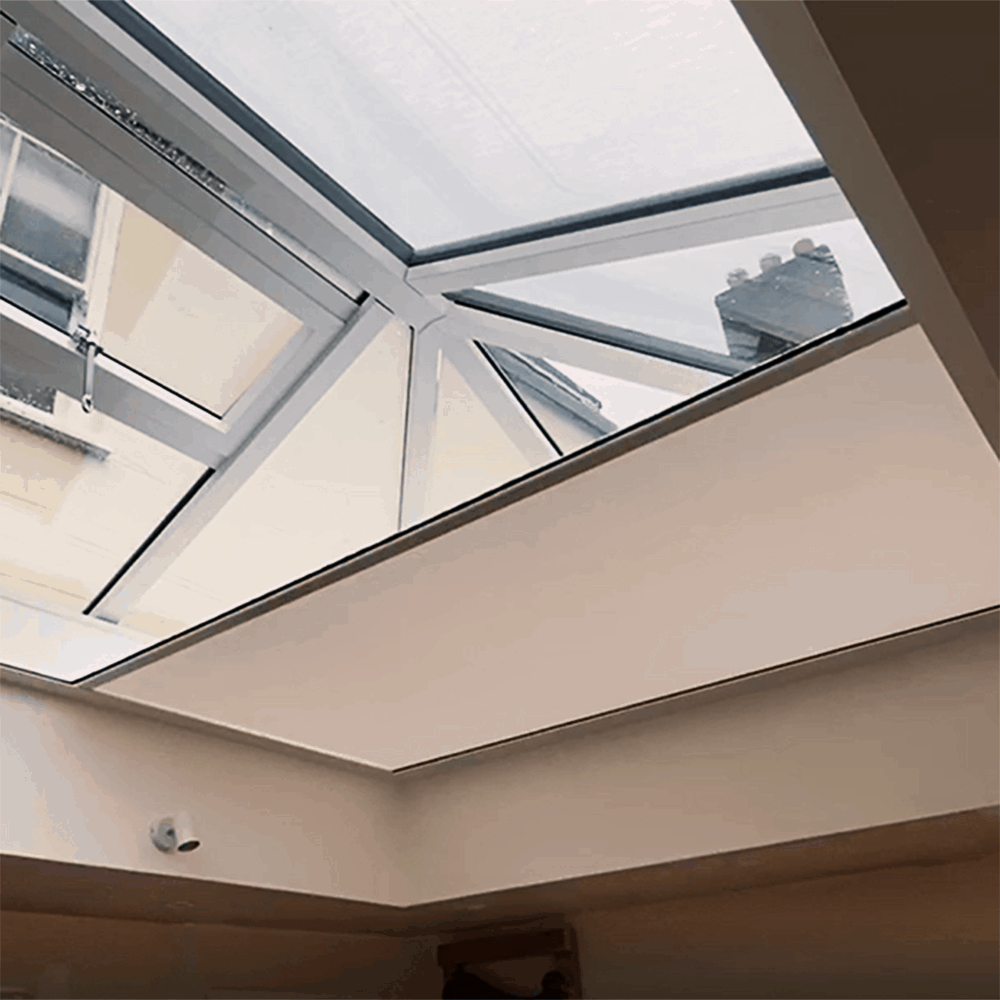
FTS
FTS stands for fabric tensioning system. An FTS rooflight blind is a system with a motor at either end of the blind.
The motors communicate with each other through an electronic control box. This control box allows the two separate motors to work as a pair. This means that as one motor winds up, the other will wind down.
As the blind closes and the fabric pulls across the blind, one motor will lock and the other will slightly tighten the fabric. This gives you a very smooth appearance on your fabric.
CTS
CTS stands for constant tension spring. As the name suggests, these blinds have a motor at one end and a CTS unit at the other end. A CTS unit, unlike a standard spring, keeps the amount of force the same no matter how open the blind is.
The benefit of this is the amount of tension on the fabric doesn’t reduce at any point. When tension drops, fabrics will sag. With constant tension being applied, you don’t get this issue.

Double-roller or Spring-roller
Spring-roller systems are similar to CTS systems in that they consist of a motor at one end and a spring at the other. However, spring-roller systems use a traditional torsion spring rather than a constant tension spring.
With a traditional spring, it is under most tension when it’s tightly wound e.g. when the blind is closed. When the spring unwinds, tension is released. To counteract any fabric sag, most manufacturers will put the fabric roller at the spring end instead of the motor end as you do on a CTS system. This means that most of the tension is put on the fabric as the blind closes to try and keep it flat and stop sagging. However, the tension is not constant, it increases and decreases as the blind rolls up and unrolls.
It’s also worth noting that there will be a difference in noise generated by these 3 systems. With an FTS system you have two motors running simultaneously which could be quite loud. CTS systems will have the sound of one motor, plus some pinging from the tension cords. Spring roller are probably the quietest option, but they might not have the best tension.
Deciding which system is right for you will depend on your main priority. Is it budget? Noise level? Fabric appearance? Whatever your goal is, there’s a system for you.
Our Helios RL, KuroLok RL and KuroLok Twin RL systems use CTS units. The constant tension helps to keep the fabric taut at all points of travel. This gives the best possible fabric appearance and smooth operation.
For more information on this system, click here: